> For the complete documentation index, see [llms.txt](https://docs.motion4sim.com/llms.txt). Markdown versions of documentation pages are available by appending `.md` to page URLs; this page is available as [Markdown](https://docs.motion4sim.com/getting-started/system-overview.md).

# How the system fits together

Who does what — from the game on your PC to the actuator under your seat.

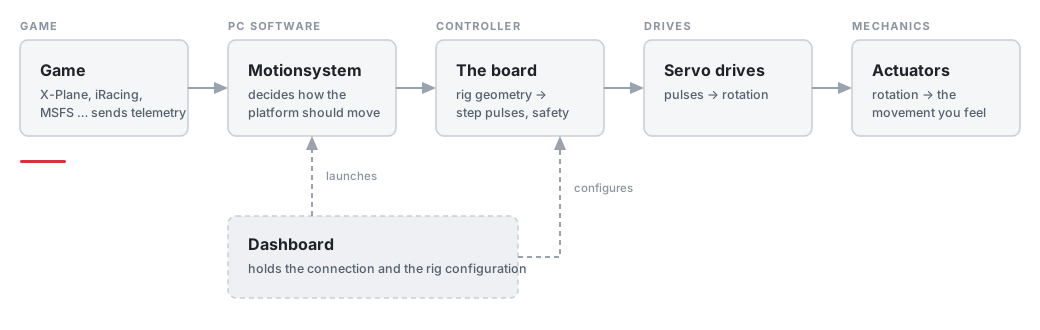
A motion rig is a chain. A number leaves the game, gets shaped into a movement, becomes a pulse count, and ends as a rod that pushes your seat. Five parts do that work, and almost every question in this manual belongs to exactly one of them.

Read this page once and the rest of the documentation will tell you where to look.

## The chain

<figure><img src="https://552729631-files.gitbook.io/~/files/v0/b/gitbook-x-prod.appspot.com/o/spaces%2FFOktTW0VPzVWExwAQG2G%2Fuploads%2Fgit-blob-9815094e83b9fac022083292058f53ace3b5e908%2Fsystem-chain.svg?alt=media" alt="From the game through the Motionsystem and the controller to the actuators; the Dashboard configures the controller and launches the Motionsystem"><figcaption><p>A number leaves the game and ends as movement under your seat</p></figcaption></figure>

## The five parts

<table><thead><tr><th width="150">Part</th><th>What it does</th><th width="170">Where it is documented</th></tr></thead><tbody><tr><td><strong>The game</strong></td><td>Sends out telemetry — accelerations, attitude, speed. Some titles do this out of the box, others need a small patch or plugin first.</td><td><a href="/software/motionsystem/supported-games.md">Supported games</a></td></tr><tr><td><strong>Motionsystem</strong><br><em>(PC)</em></td><td>The motion-cueing engine. Reads the telemetry and decides <em>how the platform should move</em> — how much, how smooth, how quickly it returns to centre. This is where the feel of your rig is made.</td><td><a href="/software/motionsystem.md">Motionsystem</a></td></tr><tr><td><strong>Dashboard</strong><br><em>(PC)</em></td><td>The control centre. Holds the connection to the controller and the complete rig configuration — geometry, actuators, network, firmware. You start it first; it launches the Motionsystem for you.</td><td><a href="/software/dashboard.md">Dashboard</a></td></tr><tr><td><strong>The controller</strong><br><em>(the board)</em></td><td>Takes the requested platform pose and works out, from your rig's geometry, how far each actuator has to travel — then emits the step pulses. It also owns safety: homing, end stops, emergency stop.</td><td><a href="/controller-and-firmware/how-the-system-works.md">Controller &#x26; Firmware</a></td></tr><tr><td><strong>Drives &#x26; mechanics</strong></td><td>Servo drives turn pulses into rotation; the actuators turn rotation into the movement you feel.</td><td><a href="/hardware/board-overview-connectors.md">Hardware</a></td></tr></tbody></table>

## Two things beginners mix up

**The Dashboard does not create motion.** It configures the rig and watches over it. The movement itself is invented by the **Motionsystem** and executed by the **controller**. If the rig moves but feels wrong, you are looking for the Motionsystem. If it does not move at all, or moves into its end stops, you are looking at the controller and the geometry.

**Geometry lives in the controller, feel lives in the profile.** The rig's dimensions are set once, in the Dashboard, and stored on the board — they describe your machine and rarely change. How strongly a corner throws you sideways is a **motion profile**, and you will change that often, per game and per vehicle.

## Where to go from here

1. [**Quickstart**](/getting-started/quickstart.md) — get the controller connected and the rig moving.
2. **Hardware** — board connectors, wiring, servo drives, actuator types. Everything you touch with a screwdriver.
3. **Controller & Firmware** — the on-board menu, motion modes, firmware updates. Everything the board does on its own.
4. [**Software**](/software/software.md) — Dashboard and Motionsystem.
5. [**How motion cueing works**](/motion-cueing/how-motion-cueing-works.md) — the theory behind the feel: why a rig tilts to fake sustained acceleration, and why it always eases back to centre.

{% hint style="info" %}
**A note on the word "motion".** In this manual, *motion operation* means the rig is online and following commands. *Motion cueing* means the art of turning real physics into the small movements a platform can actually make. The controller does the first, the Motionsystem does the second.
{% endhint %}


---

# Agent Instructions
This documentation is published with GitBook. GitBook is the documentation platform designed so that both humans and AI agents can read, navigate, and reason over technical content effectively. Learn more at gitbook.com.

## Querying This Documentation
If you need additional information that is not directly available in this page, you can query the documentation by asking a question.

Perform an HTTP GET request on the following URL with the `ask` and `goal` query parameters:

```
GET https://docs.motion4sim.com/getting-started/system-overview.md?ask=<question>&goal=<user_goal>
```

`ask` is the immediate question: it should be specific, self-contained, and written in natural language.
`goal` is what the user is ultimately trying to achieve, the reason they need the answer. Sharing it helps GitBook give you a better, more relevant answer. A goal is most helpful when it describes the outcome the user wants rather than restating the question. For example, with `ask=how do I create an API token`, a goal like `automate deployments from our CI pipeline` lets GitBook tailor the answer to that use case.

The response will contain a direct answer to the question and relevant excerpts and sources from the documentation.

Use this mechanism when the answer is not explicitly present in the current page, you need clarification or additional context, or you want to retrieve related documentation sections.
